


Review – Germs: Nerawareta Machi
One thing that has never changed for me in regards to my video game preferences is a love of big open worlds. The bigger the better. A huge world is enough to sell me on a game. Pilotwings 64 absolutely blew my mind back in ’96. Germs: Nerawareta Machi would have been an obsession, had it ever released outside Japan. And if I had a PS1 at the time. I suppose quite a few factors would need to be changed, but if it was placed in front of a younger me, I would have been obsessed.
That’s not to say it’s good, but it is an absolutely bizarre game. Just incredibly strange. What would have drawn me in, specifically, is its massive world. It’s immensely ambitious, but even more peculiar is that it sometimes sort of pulls off what it’s trying to do. Something clearly went wrong with its development, but that maybe just makes its successes so much easier to appreciate.
TARGETED CITY
You play as a nameless journalist in a nameless city. You grew up in this city, left to follow your career, and have returned at a very strange time. The closure of the local mine led to an exodus of people, which might just be an explanation for why the streets are completely empty. It doesn’t need an explanation. I wish it knew that. I wouldn’t call it dialogue-heavy, but it spends a lot of that dialogue on coy exposition.
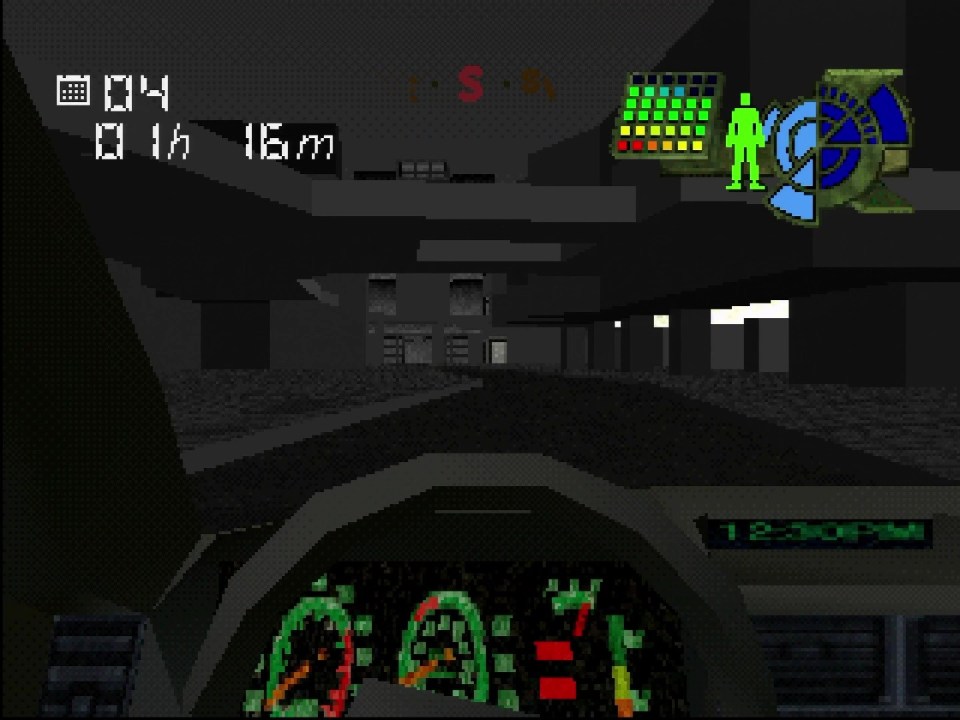
Germs: Nerawareta Machi is a first person adventure, and it’s set in an open-world that is largely (but not entirely) urban. Strangely for a PS1 title, it’s an exceptionally large city. The significant draw fog and slow vehicle speed makes it hard to be certain, but by my rough estimation, it’s larger than GTA 3’s Liberty City. At the very least, it’s comparable.
You receive emails and phone calls suggesting you check out certain places in town, and go and investigate them as you see fit, though there is a somewhat strict progression. In a way, it’s a prototypical Deadly Premonition or The Sinking City. Or an icarian attempt at following up on Mizzurna Falls (another weird Japan-only PS1 game).
You can travel using bus or train, but you’re also furnished with a car to get places. The city itself is completely empty. There’s no traffic, but there’s the sparse sound of traffic. There are very few colours out in the world; it’s mainly greyscale. Large, pink arrows hover in certain spots to suggest travel routes or signify that you can enter a building. Windows glow yellow at night, even without any signs of life. It’s a strikingly unusual atmosphere supported by the aforementioned draw fog and a day/night cycle.

FIRST GEAR
I have no idea if the greyscale city is a deliberate design choice or one borne from the technical challenge of fitting such a large urban area into a PS1 game. Some of the buildings are just flat shaded. Many of the structures themselves are extravagantly designed and the architecture features a visual depth that reminds me of Tim Burton’s depiction of Gotham City in Batman, just, you know, with a verticality completely obscured by fog. For me, it implanted the belief that there was someone on the team who just wanted to build a city, and that’s what they single-mindedly did. The art in general is miles ahead of the actual gameplay.
This is very apparent when it comes to the car, which is just borderline fine. It steers well enough, but get stuck on things easily and slows to a crawl the second you hit a curb…
Actually, now’s probably a good time to mention the game’s bizarre control scheme. For some reason, they chose to have triangle move you forward and X to move you back. The directional buttons move your head, allowing you to look up or turn around. L1 and R1 are strafe. The menu buttons are largely contextual. Pressing Select in a car opens your map, while select in a building brings up your weapon inventory. Not completely unintuitive, but takes some getting used to.
Germs is just strange in every facet.

EMBRACING CHANGE
While the city itself is an example of Germs actually reaching its ambition, most other things fall very short. The sound, in general, is godawful, but this is largely due to the poor quality of the sound clips than the design itself. A restaurant plays, for example, what has to be a one-second loop of background chatter. They perhaps thought that random human noise would be identical from second-to-second, but that’s not the case when it comes to short clips. Your ears will probably pick up someone saying something repeatedly.
This isn’t a one-off thing, your car also makes victims of your ears by just playing a generic engine noise. By that I mean, like, a low grumble. It doesn’t really make the sound of it accelerating, and that’s just wack. How hard is it to set the sound to rise in pitch as your car picks up speed? I don’t know, that’s not my racket, but it sounds easy when I put it in words.
On the other hand, the music is a mixed bag. Some of it is just haunting in its weirdness; enjoyable enough and easy to listen to. Other times, it’s a strange collection of sounds, most strikingly in the hotel, which seems to be centred around the chaotic non-melody of bamboo wind chimes.
But then, most of the game is entirely silent, which adds to the eeriness of it all.
However, the important thing is that whenever you step out into the open world (and it finishes loading), it fades in with a “Bwwooooooooow” sound. And that’s so great. I love that sound. You step out of your car and, just, “Bwwooooooooow.”

BWWWOOOOOOW
Anyway, thus far, I’ve largely just described the aesthetic and atmosphere of Germs, but I have to stress: that is a big, big part of what make it so interesting.
The story itself has you, as a reporter, investigating weird stuff that’s been going on in the city. You quickly learn that a space virus has hit, and this causes people to mutate into strange and hostile creatures.
But despite the investigative angle, the meat of the game involves going to a location and hunting down all the mutants. You become sort of an exterminator. The church literally emails you and is like, “Can you come here and kill this bad guy?” You go to the cathedral, talk to four people, then climb the bell tower to kill these things.
Sometimes, it isn’t entirely clear what you should be doing, but there are only so many places that something can happen. At one point, I decided I’d drop in on one of my contacts on my way back from another investigation, and I found the spot overrun with bad dudes. It felt so organic, and then I went back to the office and found an unopened distress email followed by “Thanks for killing everybody.”
Speaking of killing everybody, you can kill everybody. You’re not supposed to. Important NPCs will just come back without explanation, but if you kill too many innocents, you’ll get arrested. Unfortunately, who is considered innocent (is anyone?) is a bit of a mystery. One time, I returned to the office and got picked up by the cops. I was immediately released for lack of evidence, but I was confused. Who wasn’t I supposed to kill?
Speaking of which, mutated people speak with yellow text, but not all of them are hostile or even bad. The story sometimes suggests that mutating isn’t a bad thing as long as you ignore the overwhelming impulse to exterminate humanity.

ALIEN LANGUAGE
In fact, you can be captured and mutated if you are killed by an alien. You then have to go to the hospital, where they just straight-up cure you. Easy as that. Gosh, what a trip.
But while you’re mutated, people (for obvious reasons) react differently to you. One of the most surprising aspects of this is that, when I went into a restaurant, it adapts to suggest that the employees are mutants and that’s why they’re willing to serve you. It’s eerie, and kind of neat.
Unfortunately, the currently available English translation isn’t great. There’s a fixed character width, which is fine for kanji and hiragana, but English takes up more real estate. So, it’s limited in what can be written in dialogue, and words aren’t line broken, so everything is fractured.
Even if the font looked appealing, I’m not sure the translation is of solid quality. It often sounds like it’s just translating directly and ignores context, which results in ambiguous sentences that make implications that they shouldn’t. Like a disembodied list of dialogue was directly edited external to the game itself. One example that comes to mind is a line of dialogue that suggested someone had attacked the newspaper office and killed a bunch of people.
The newspaper office has two inhabitants: the player and their assistant. Don’t worry, the assistant is okay. There’s also no sign of attack. I dunno what it was supposed to be referring to.
To be absolutely fair, the author of the translation states that it’s incomplete. For the purposes of penetrating the language barrier, it works. If anything, it adds to the game’s surreal quality.

DYING JUST TO GET THE DISEASE
The unfortunate thing about Germs is that it is absolutely dry humping greatness. It just feels as though it’s incomplete, like playing a game deep in early access. If this isn’t a case of a game getting kicked out the door before being finished, then only the artist (or artists, since there are no credits) actually pulled their weight on the team. Which makes sense, because the developer, KAJ Corporation, was initially a computer graphics contractor, and this was their only game. That would probably explain why the visual design is so impressive, while everything else is varying shades of terrible or otherwise incomplete.
The best way to illustrate this unfinished state is the Germs’ complete lack of currency. You go to a restaurant, but you’re just given food. You’re just given maps. You’re just given weapons. There’s no earning or spending of money. That’s fine from a functional standpoint, but it robs the game of connective tissue.
Even still, I think Germs is almost essential for chrono-agnostic person with an interest in… ambition. Germs is a lot. Even with a lack of depth, it’s still broad enough that there’s an abundance of interesting concepts. It’s just functional enough that, outside of questionable acoustics, it’s not a very uncomfortable experience. And spread over top of everything is a thick layer of delicious, creamy weirdness. It’s offensive that a game from 1999 can contain it all. A bizarre mutation that will stick with you.
7/10
This review was mostly conducted on a PSOne using a backup copy of the game burned onto CD-R. It was patched with Grundo1561’s English fan-translation. Some screenshots were captured on an emulator, but I can’t remember which one.

Zoey Handley
Zoey made up for her mundane childhood by playing video games. Now she won't shut up about them. Her eclectic tastes have worried many. Don't come to close, or she'll shove some weird indie or retro game in your face. It's better to not make eye contact. Cross the street if you see her coming.


You May Also Like

Old wounds and making sense of Swery

Review – Game Dev Story
